Everything here is observation, not accusation. The longer I travel, the less interested I become in landmarks and the more interested I become in life. Bangkok simply happens to be one of the few places where both are impossible to ignore.” ~ Shannim Mohd Sa’ad
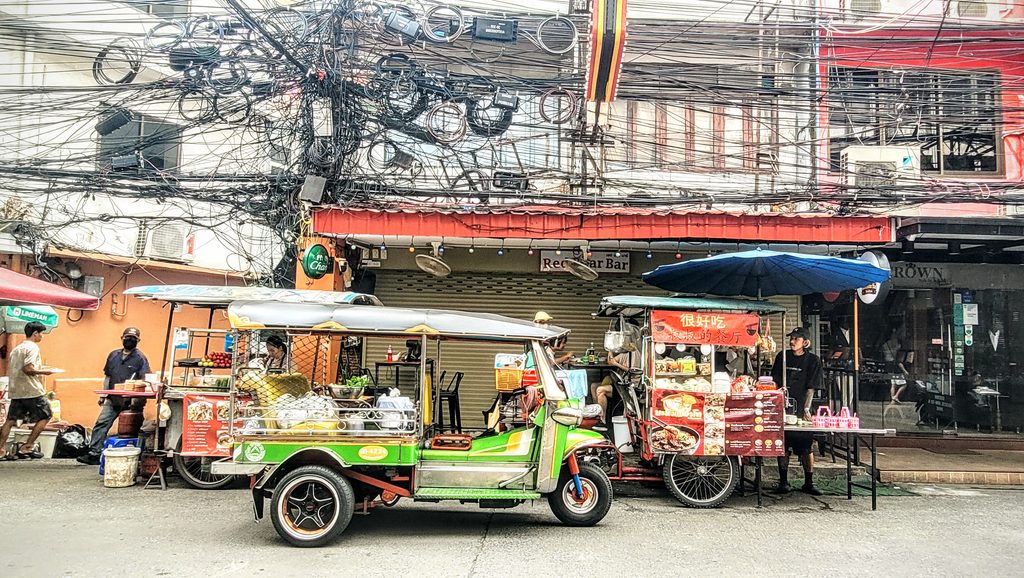
There is a Bangkok that lives on postcards – golden temple spires catching the late sun, tuk-tuks weaving through traffic like they own the road, the glass towers of Siam Paragon and IconSiam rising over air-conditioned silence. It is a beautiful city, and I don’t begrudge anyone who falls in love with that version of it.
But it isn’t the Bangkok I keep coming back for.
Everyone Thinks I’m Thai
Here’s a small, strange fact I’ve never worked out how to explain: every local I meet in Bangkok speaks to me in Thai first – taxi drivers, street vendors, monks outside temples, strangers on the BTS. Flattering, if I actually spoke Thai. I don’t. I know about twelve words, mostly for ordering food or apologizing, which covers a surprising amount of travel in Southeast Asia.
The conversations never always end well, but they usually end well for me. A monk once asked me something with total, serene confidence – I had no idea what, shrugged at a monk, which felt like a genuinely bad way to accumulate karma, and somehow the whole misunderstanding ended with us taking a selfie together anyway, both of us smiling like the language barrier had been the plan all along. Tuk-tuk drivers quote me local rates before they’ve even finished sizing me up, which I’ve never had the heart to correct. A woman at a noodle stall once asked me something so directly that I panicked and just repeated her last word back, like a parrot with a concussion.
Eventually I usually own up – not fully, just enough. “Malaysian,” I tell the locals, which is close enough to true to feel honest and vague enough to explain the accent. Same same, but different – Thailand’s own unofficial national tagline, printed on more T-shirts in this city than the King’s face. It’s the perfect cover story, really: Thai enough to be trusted. Foreign enough to dodge the blame.
None of it stops the trick from working, though. For those first few seconds, before it all collapses, I get treated like a local, not a tourist steered toward the overpriced menu. That’s the beauty of it – not being Thai, but everyone assuming I am anyway. It’s a small thing, but it changes what people are willing to say to you, and later in this piece, it changes an entire conversation.
The City Between the Malls
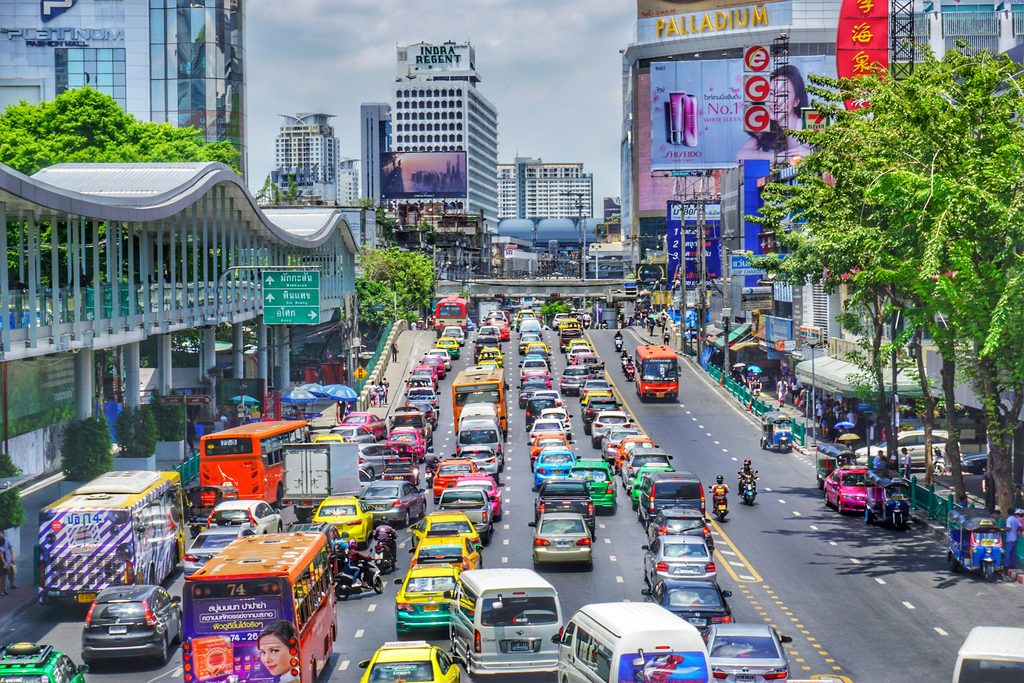
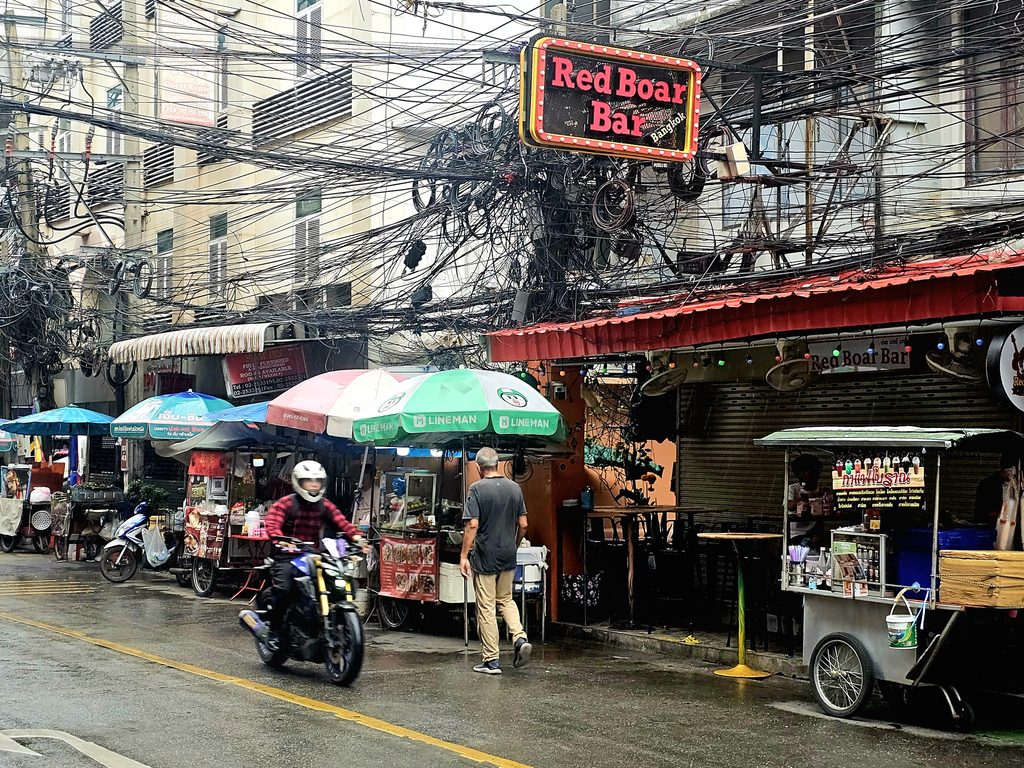
The Bangkok I love starts a few streets away from the malls, where the air changes. It smells like charcoal and burnt sugar and the river, cut through every so often by a wall of exhaust fumes as the traffic locks solid at an intersection – three lanes trying to become five, a motorbike taxi threading through the gap between a truck and a tuk-tuk with a foot to spare.
The noise never stops. It just changes costumes by the hour – tuk-tuks at dawn, karaoke by noon, a full-volume argument in Thai at 2 a.m. about something that clearly couldn’t wait. Horns aren’t warnings, they’re punctuation. Everyone honks, constantly, for reasons nobody could name if you asked. Somewhere in it, an ambulance screams uselessly at a wall of traffic going nowhere. Nobody looks up. Even the sirens have learned to queue. In a city this loud, a siren isn’t an emergency – it’s just one more voice added to the noise.
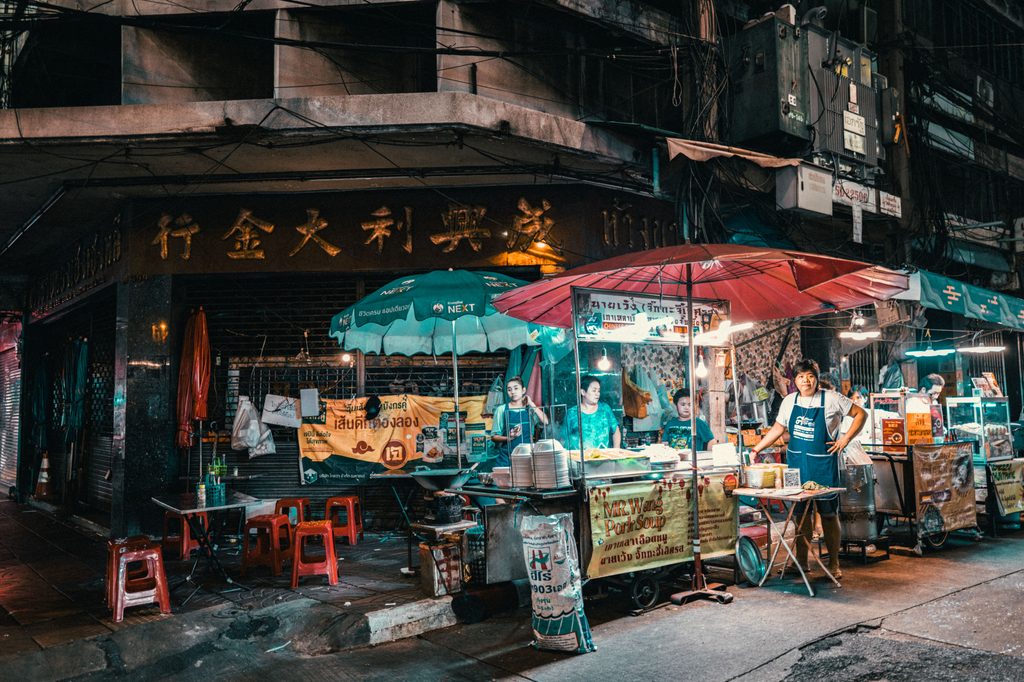
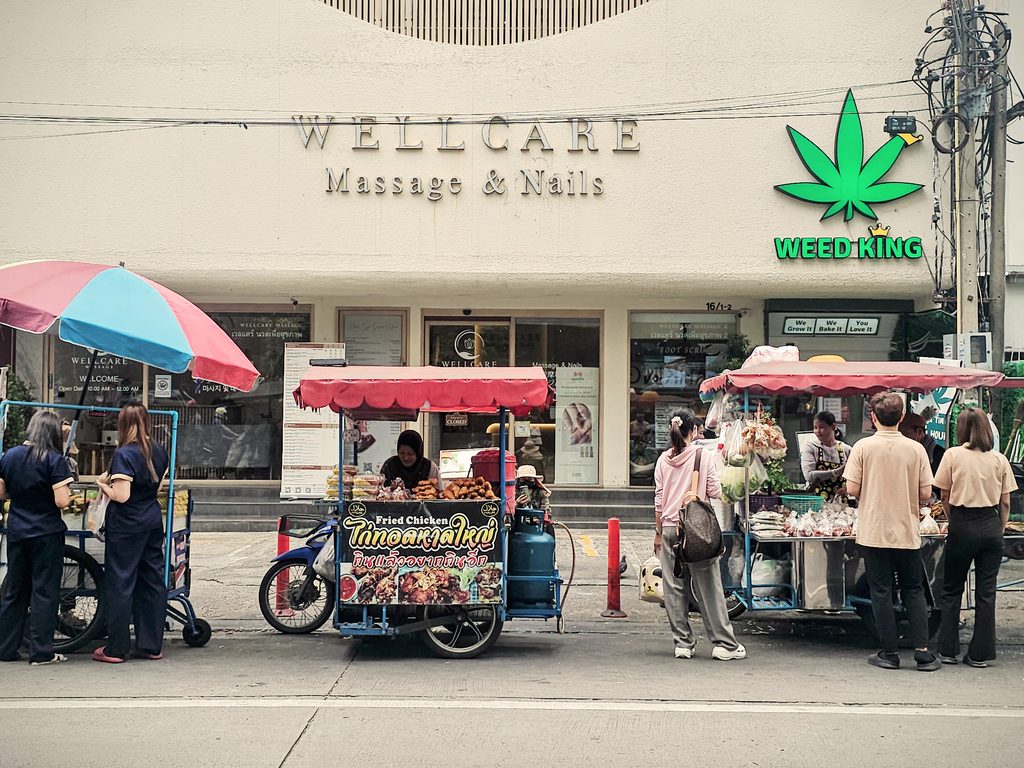
Further along, a woman fans a grill of skewered pork with a woven paddle, sparks lifting off the coals each time smoke gathers too thick, the smell of char and sweet marinade pulling people over from half a block away. A few carts away, another woman pounds a mortar and pestle with the rhythm of someone who’s done it ten thousand times before, garlic and chilies and green papaya bruising into somtam. Across the soi, a man ladles beef noodle soup from a vat that’s probably been simmering since before sunrise, the broth dark and fragrant, bean sprouts and coriander added last with a practiced flick of the wrist. There is a rhythm to it all – the hiss of a wok, the ring of a bicycle bell, someone haggling cheerfully over the price of dragon fruit – and for all the hardship layered into this city, there is real beauty in that rhythm too. It doesn’t cancel out the hard parts. It sits right alongside them, which somehow makes both truer.
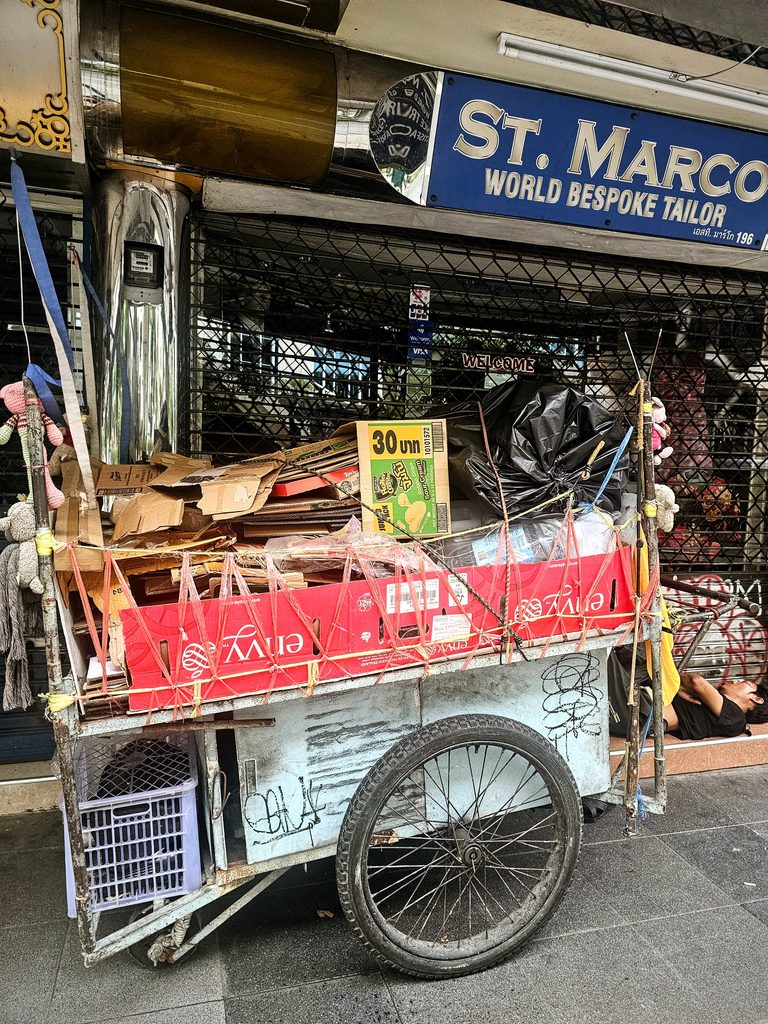
Outside a 7-Eleven, its fluorescent light spilling harsh and white onto the pavement, a woman sits low on the concrete step, almost lying against the wall, packets of tissues fanned out in front of her on a cloth. She doesn’t call out. The exhaustion in the way she’s arranged herself says everything about how long she’s been there and how long she’ll stay. People step around her to get their Slurpees, their Chang beers and their late-night snacks, and she barely looks up.
(A note for anyone bringing family: this stretch of the city isn’t obscene, but it isn’t sanitised either – it’s worth deciding for yourself, street by street, what you’re comfortable walking your kids through.)
When the Neon Comes On
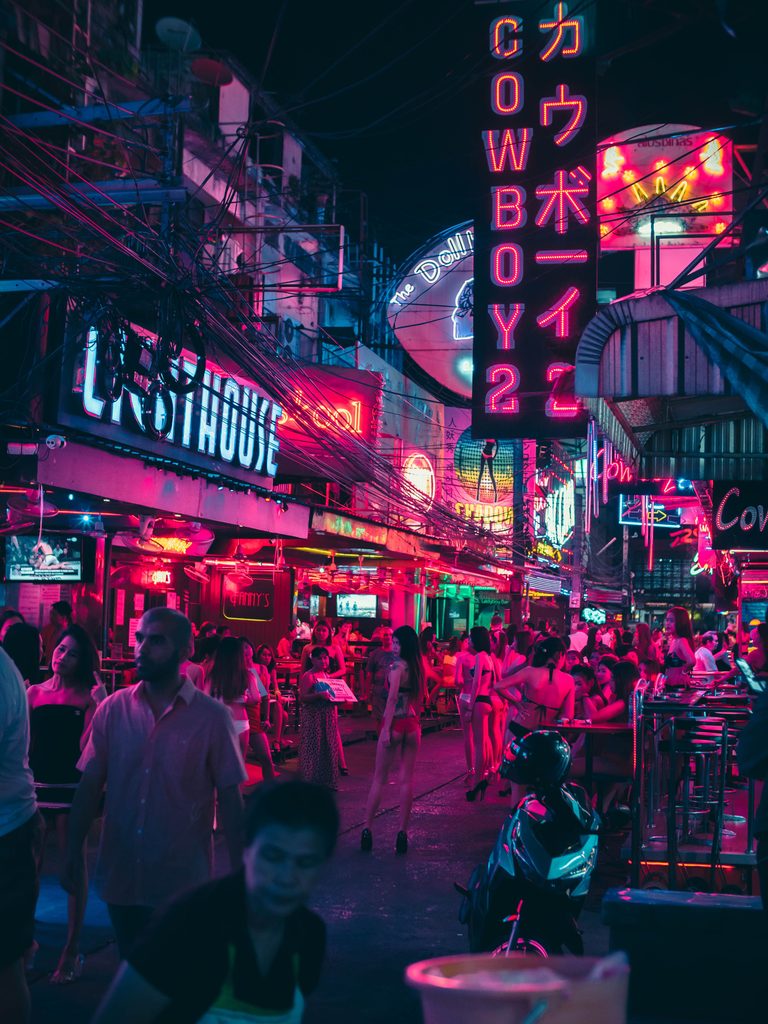
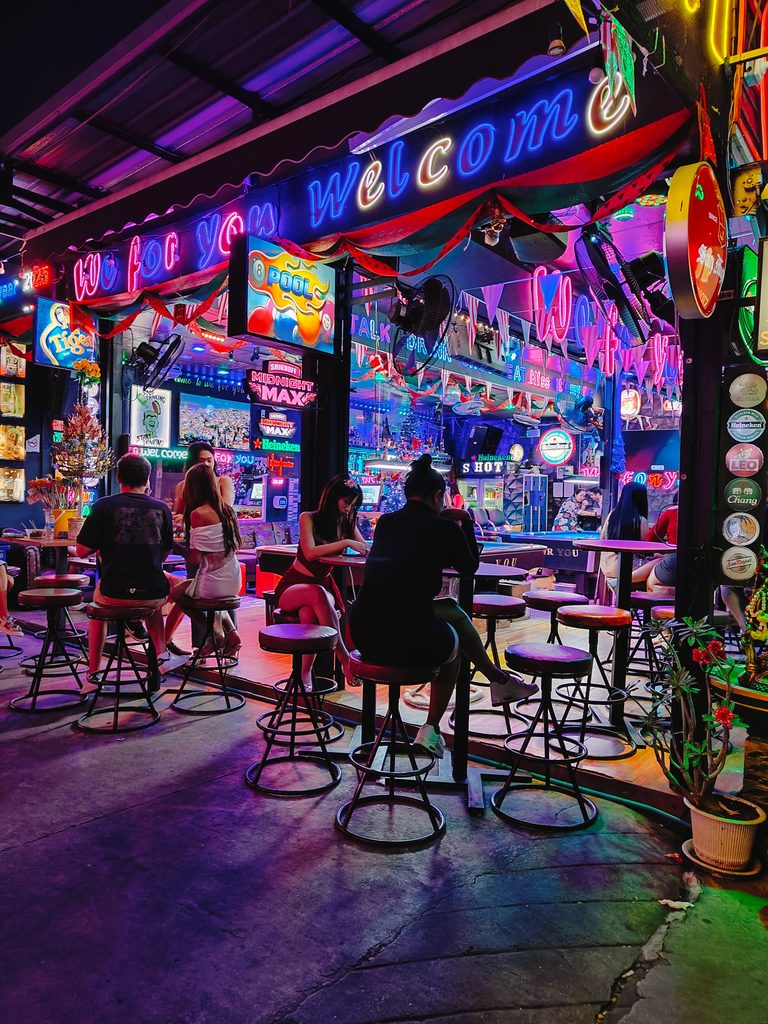
Further on, past the 7-Elevens (or 7-E my children call it now) and the noodle carts, the streets change keys entirely. Soi Cowboy lights up like a runway – a single lane packed wall to wall with neon signs stacked three deep, pink and electric blue bleeding into each other, girls in matching numbered outfits perched on stools outside each bar calling out to anyone who slows their pace. Soi 4 is quieter but denser somehow, ladyboys working the pavement in heels that add half a foot to their height, faces built with real precision – sculpted brows, filled cheeks, jawlines shaved down over months of surgery – the transformation that takes years and courage most people will never have to summon. Some of them are stunning. Some look tired underneath the makeup in a way concealers can’t quite manage. Inside the bars, men who could be somebody’s grandfather sit with an arm around each of two girls young enough to be their granddaughters, and nobody in the room reacts to it, because it isn’t unusual here. It’s just math – his money, her youth, and neither side pretending otherwise.
Between the bars, whole rows of massage parlours sit lit up with backlit menus taped to the glass, and the girls out front span the full range of what’s actually on offer. Some are there purely for the foot rubs and the traditional Thai massage – legitimate, hard, physical work, hours on their feet or knees for tourists who’ll never tip properly. Others sit outside parlours advertising “soapy massage” or “jacuzzi massage,” the euphemisms doing exactly as much work as they’re meant to. Everyone on the street knows which is which without needing to ask, and the girls themselves couldn’t care less which category a passerby assumes they belong to – it’s just business, either way.
Desire has a curious way of softening scepticism. What I’ve never been able to shake is the naivety of a lot of the men who show up looking for it. Some genuinely seem to believe the flirting is real, that the girl draped over them at 4 p.m. is there because she likes them specifically, not because he’s the customer in front of her. The laughter feels personal. The attention feels genuine. Perhaps it is, for a while. Perhaps it isn’t. Either way, when your income depends on making someone feel seen, the line between connection and transaction can become remarkably blurred.
I’ve wondered, more than once, how much of what these girls earn actually reaches them after the bar takes its cut, after the “drinks” they’re pushed to sell, after whatever agent or mamasan sits above them in the chain. I’ve never gotten a straight answer, and I suspect the honest one varies wildly parlour to parlour, girl to girl. It’s easy to romanticise the hustle from the outside. It’s much harder to know what it actually nets someone at the end of a long, physically punishing night.
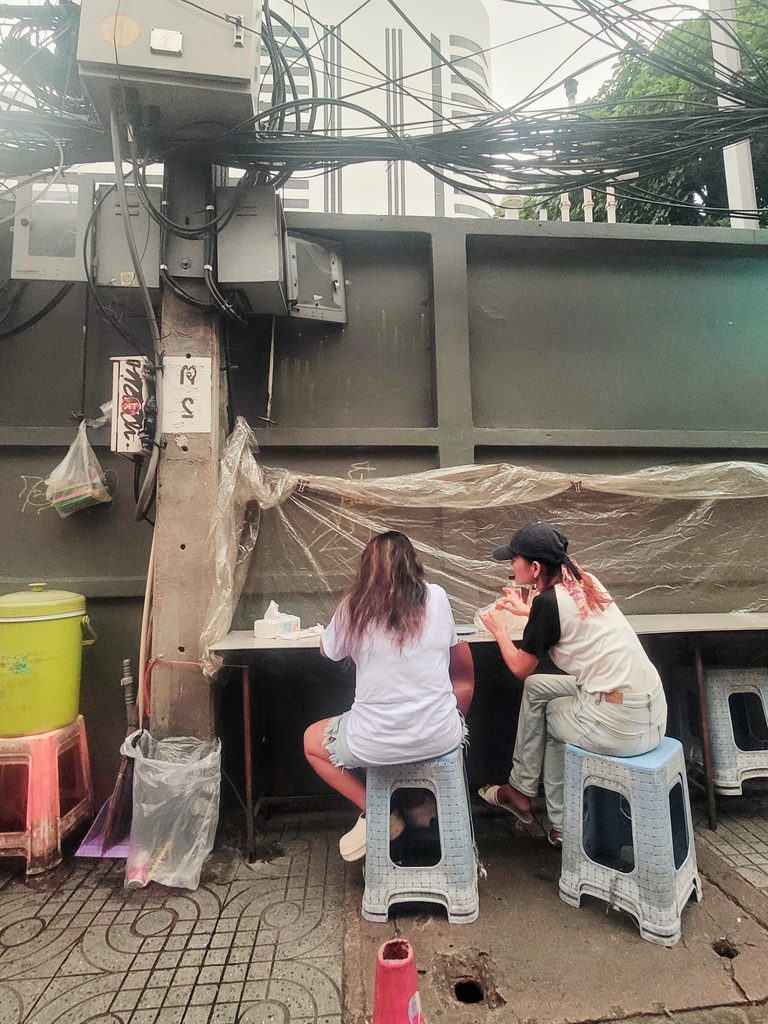
And then, a few steps further, it’s just food again – because that’s Bangkok’s other trick, how fast it can swing your stomach and your conscience in opposite directions within the same block. A woman deep-fries pork liver in a wok blackened from years of use, turning each piece with a long pair of chopsticks, the smell sharp and unmistakable even from across the street. Next to her, someone grills chicken skin flat against a wire rack until it blisters and curls, crisping up gold and amber, sold in little paper cones for less than the price of a bottled water at the mall. People eat standing up, off plastic stools barely big enough for a child, elbow to elbow with strangers, and nobody seems to mind.
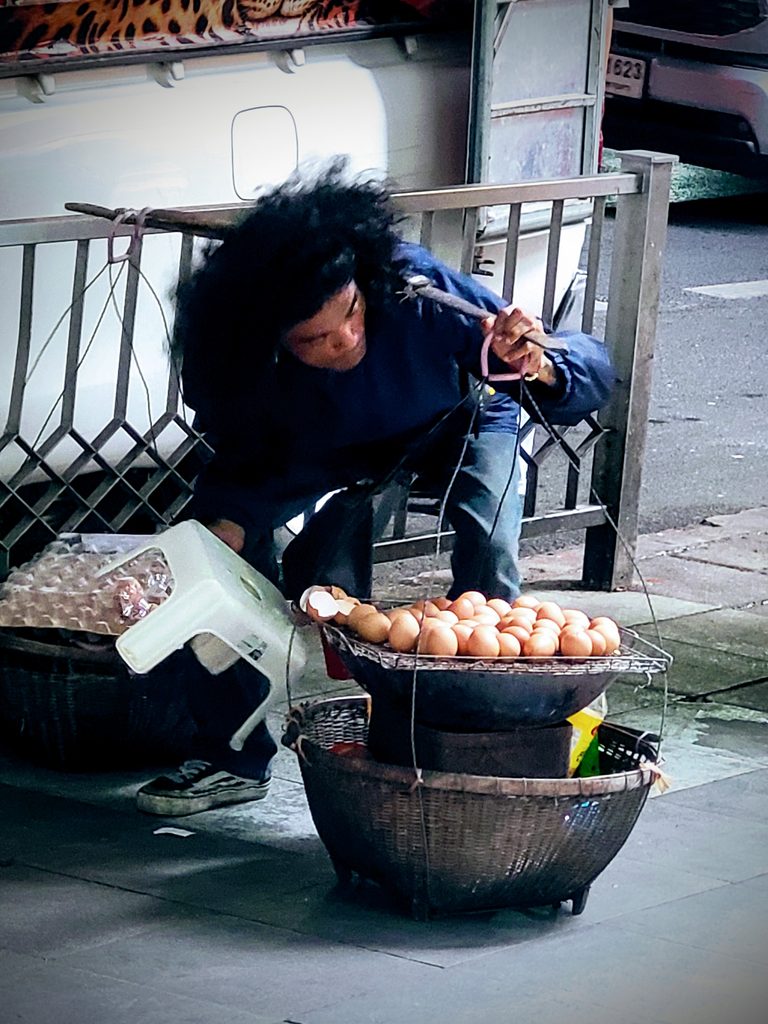
It’s this – the density of it all, the collision of hardship and neon and street food and quiet dignity, all lit unevenly by fluorescent tubes and pink signage – that makes Bangkok, I think, one of the best cities in the world for street photography. You don’t have to look for a shot here. You just have to be standing in the right spot when the light hits the smoke off a grill, or when a ladyboy checks her reflection in a shop window, or when the old man with the eggs pauses under a streetlamp to adjust the pole across his shoulders. The city hands you the frame. You just have to be paying attention.
The Night She Thought I Was One of Her Own
I was in Bangkok for a Linkin Park concert, years ago now. Afterward I ended up alone at a bar, nursing a drink, half-watching the room the way you do when the adrenaline from a gig hasn’t fully drained out of you yet. A woman sat down next to me and started talking, easy and familiar. She thought I was Thai, same as everyone else every single time, and unlike the tourists around us she didn’t switch into her working English or her rehearsed small talk. She just talked to me like a local, which meant she talked to me like a person, not a wallet.
Her eyes were glassy when she spoke, whether from the whiskey or the weed, or from wherever her mind went when she told the story, I couldn’t say. Maybe both; Bangkok rarely offers just one explanation for anything. She told me how she’d ended up there.
I don’t know if that’s a story she tells every stranger who sits next to her, or if that night, for whatever reason, it was just me. I’ve wondered since whether stories like hers are less a confession and more a survival tool – something offered up to a sympathetic ear in the hope that empathy might, one day, translate into something more: a way out, a foreign husband, a quiet countryside somewhere in Europe far from all of this, or at least another drink. I have no idea if any of her story is true, or if it’s just what she’d decided a listening stranger wanted to hear. It doesn’t actually matter. I listened, because that’s what she seemed to need, and at some point she asked me to buy her a drink. I did. It felt like the least dramatic decision I made all night, and in hindsight it might have been the only one that mattered.
Then she hugged me. She thanked me, genuinely, it seemed, glassy eyes and all, and said no woman had ever done that for her before. Just sat and listened. She said she was tired, ready to call it a night, and for a second I believed her. I think she believed her too.
Then three Indian men walked in.
She was up and across the room before I’d finished my next sip – no goodbye, no hesitation, a full costume change with no wardrobe department. Whatever tiredness she’d just told me about vanished, replaced instantly by the version of herself the job required. Twenty minutes later, she left with them.
It was only after she’d left that the question crept in. Had I simply fallen for a well-practised story? After all, I had bought her drinks. The longer I thought about it, the less the answer seemed to matter. For fifteen minutes, she wasn’t trying to negotiate a price or persuade me to stay. She was simply talking, and I was simply listening.
That hug was real. It cost her nothing to fake gratitude, and she didn’t need to fake it with me – I wasn’t a customer, I wasn’t paying, I was just a stranger who’d let her be a person for fifteen minutes instead of a product. Whether our conversation was completely genuine or partly performance is something I’ll never know. Perhaps she doesn’t know anymore either. When your livelihood depends on blurring the line between connection and transaction, I imagine the two can become difficult to separate.
What I do know is that she still had it in her to give, after however many hundreds of nights like that one – and whether it was real or rehearsed, it is something that I remember even over a decade later.
The Hotel Lobby
Not every scene I’ve watched play out was about the women themselves. Some said more about the men, the visitors. One evening, checking in at a hotel in the heart of Bangkok, I overheard the front desk staff stopping a European guest at the elevator. Standard procedure, they explained: any visitor has to register at reception, ID and all. The guest, a Frenchman by his accent, had someone with him – dressed for a night out in a way that made her line of work fairly obvious. He waved the request off, said he’d already booked the room for two, no registration needed. The receptionist held firm, politely, and asked for the woman’s ID. She didn’t have one on her.
That’s when he dropped the courtesy. He’d been staying there three nights, he said flatly, and had brought guests back every night without ever having to register a single one. Not a request anymore – an assumption, stated like a fact he’d already settled with someone else.
I won’t pretend to know how that particular exchange ended, but it stuck with me longer than almost anything else from that trip – not because it was shocking, exactly, but because of how shamelessly he was about being overheard.
Whatever this city’s hardship costs the women in it, some of the men who show up looking for it seem to have long since stopped noticing there’s a cost at all. Perhaps that is the effect of Bangkok.
Six Games of Connect 4
One night, years later, I took my son, thirteen at the time, to one of these bars. There were girls around, but nothing obscene, nothing he couldn’t have walked past on any street in the city. He spotted a Connect 4 board on one of the tables and asked if he could play. One of the waitresses, half-joking, said sure, the winner gets a free drink.
He won. Then he won again. The first waitress lost and waved another one over, half amused, half competitive. She lost too. Word seemed to travel fast, because by the third game a small crowd had gathered around our table – waitresses, then security, then someone went and got a woman from a bar across the street, apparently their best player. My son beat her as well. Six games in a row, in the end, against a rotating cast of what I’m told are usually very good players. Visitors are warned not to bother challenging the girls working in bars at playing pool or Connect 4, because they always win. Not against a calm thirteen-year-old, apparently.
By the fourth free drink, he had a small problem: he doesn’t drink alcohol. Four bottles of water later, he finally told them no more prizes, please. About eight people had ended up crowded around the table by then, just watching a kid quietly out-think half the street. It’s one of my favourite memories from any trip we’ve taken.
Walking back to the hotel that night, he asked about a scene he’d quietly taken in – a grey-haired man old enough to be a grandfather, wedged comfortably between two young women in glittering skimpy tops, his hands resting casually around their waists as they laughed over another round of drinks. So I told him. About survival. About transactions. About how not everyone gets to choose the shape their life takes, and how a lot of what we’d walked past that week was one version or another of people doing what they had to do to get by.
I don’t know whether every parent would have had that conversation. I only know I was grateful to be beside him when the question came. Travel has a way of showing our children the world as it is. There will always be parts of the world I’d rather they didn’t have to understand yet, but travel doesn’t arrange itself neatly around childhood.
Our job isn’t to pretend those moments don’t exist. It’s to help them make sense of them.
Am I Wrong for Showing Him This?
Some people will read this and decide I’ve completely lost the plot. A thirteen-year-old in a Bangkok bar surrounded by Thai waitresses does sound like a red flag with a passport. Read as a headline – “Mum takes son to Bangkok bar, kid befriends the working girls over Connect 4” – I’d probably click on that story too. Headlines however have a habit of removing the only part that really matters: the thirteen years of parenting that came before them.
My son has travelled more than most adults I know. He’s eaten things in Vietnam I still can’t identify and wouldn’t try to. He negotiated a tuktuk fare in Chiang Mai while I stood there useless with a phone map spinning in circles. This was not his first rodeo, and it definitely wasn’t his first bar – not because I hand him beers, but because in most of the world outside a handful of very online, very anxious countries, “bar” doesn’t automatically mean “adults doing something you must be shielded from.” Sometimes it just means the place with the good pad kra pao and a Connect 4 board, and the fact that a night out ended in a red-light district hustling win-streak has become one of our proudest parenting stories tells you everything about how seriously I take the supposed scandal of it.
He’s seen more of the real world by thirteen than some kids will see by thirty, mostly because those kids aren’t allowed to walk to the corner shop alone, let alone cross a Bangkok street where the traffic laws are more of a philosophical suggestion than a rule. There’s a version of modern parenting that treats the entire world as a hazard to be filtered out: kids driven two streets to school, playgrounds padded within an inch of their lives, screen time managed to the minute while actual, unscripted human contact gets rationed like it’s dangerous. And then those same kids get put on a plane at eighteen with zero practice reading a room, judging a stranger, or realizing that most people, even the ones working jobs you don’t understand, are still just people.
I’d rather my son learn what desperation looks like on a real human face, at thirteen, standing next to his parents who can answer his questions, than have him find out what it looks like for the first time alone, at twenty-one, on a gap year, with nobody to ask. He’s a well-travelled kid, mature for his age, aware enough of his surroundings that a night in that part of the city didn’t rattle him. It just gave him questions, which is exactly what it should give anyone. I don’t shield my kids from the harder textures of the places we visit. I just make sure we talk about what we see.
Perhaps that’s one of the responsibilities of travelling with children, to places like this: you don’t get to choose every lesson the world puts in front of them. You do get to help them decide what they take from it.
And What About the Men?
I’ve written a lot here about the women – what they carry, what they perform, what it might cost them. Less has been said about the men on the other side of it, mostly because men rarely write about themselves this honestly. Some are obviously alone, obviously here for exactly this. But plenty aren’t.
I’ve watched men who mentioned a wife in the same breath as their drink order sit with an arm around a girl wearing not much more than a nipple cover, entirely unbothered by the arithmetic of it all. The ordinariness stinks. Wedding rings still on fingers. Phones lighting up with messages from home. A wife mentioned between sips of beer. Then an arm around another woman, as though the two lives had nothing to do with one another.
Somewhere, most of these men have a home, a family, kids who still believe the postcard version of Dad. Trust, apparently, is one of the few things that doesn’t make it through the flight.
That’s the part that actually turns my stomach. Not the transaction itself, that’s just business, plainly priced, no illusions on either side of it. It’s the ease of it. The total absence of anything on a man’s face that looks like conflict, let alone guilt. Whatever gets carried home from a night like that, it clearly isn’t the weight of it, for him.
I’ve watched decades of it, one way or another. Marriages that didn’t survive a trip like this one. Diseases carried home and folded into a story about food poisoning or a bad flight. Grown men, the next morning, swearing they don’t remember the night before – not because the whiskey was that strong, but because not remembering is a far more comfortable place to live than admitting they chose it. Bangkok doesn’t make men unfaithful. It just removes every excuse they’d normally have for not getting caught doing it somewhere else.
The truth of any of it, what really happened, what it meant, whether it meant anything, lives in exactly two people: the man, and the woman or ladyboy next to him. And she’s rarely thinking about his wife. And she’s rarely thinking about his wife. She’s thinking about rent, a debt, a family of her own she’s supporting the same way he claims to support his. Or maybe, more simply, she’s thinking about a hotel bed better than her own for a night, a hot shower with real pressure, a night of Netflix and someone to half-listen to who isn’t asking for anything she hasn’t already agreed to. Chuff knows.
At the end of the day, it’s a transaction, simple as that. That’s part and parcel of life in Bangkok.
What I Actually Value About Bangkok
I keep coming back to Bangkok for a hundred ordinary reasons – the food, with friends, the flights that are somehow always cheap, but it is none of those that I actually remember afterward. It’s the egg seller who’s walked the same soi for thirty years. The woman on the 7-E steps, tissues fanned out in front of her. The ladyboys who rebuilt themselves feature by feature into who they wanted to be. The girls at the bars, doing a job I hope none of them chose freely but understand, on some level, why they might have. A stranger’s hug that cost her nothing to fake and clearly wasn’t fake at all. My son, happy and smiley, beat the bar’s best player six times running while eight strangers cheered him on.
There’s something about standing in the middle of all of it – the smoke, the neon, the traffic that never stops, a whole city living out loud with nothing hidden and nothing dressed up, that switches something on in me I don’t fully have a name for. Not pity. Not guilt, exactly, though there’s some of that too. Something closer to attention. Bangkok doesn’t let you look away, and somewhere in refusing to look away, you start noticing things about your own life you’d stopped paying attention to.
So here’s what I’d actually ask of anyone reading this, next time you’re somewhere unfamiliar: put the phone down for one block. Make eye contact with the person selling something on the pavement instead of walking past them like scenery. Ask yourself, honestly, how much of “the real world” you’re willing to see yourself, let alone let your kids see, and whether the answer says more about them, or about you. You don’t have to go to Bangkok to find a version of this. Every city has an egg seller. Every city has someone glassy-eyed at a bar with a story you’ll never fully know is true. You just have to be paying attention.
Bangkok’s glamour is easy to sell. Its hardship is easy to gawk at. What’s harder, and what’s actually worth writing about, is that inside all of it, gratitude keeps finding a way through, usually when you’re not looking for it. That’s the Bangkok I carry with me. Not the skyline.
It’s thinking about a woman who’d been paid to disappear into other people’s fantasies all night still had one honest hug left in her, for a stranger who wasn’t paying for anything. An old man still walks the same soi with the same coals, because someone will always need eggs. And a thirteen-year-old in flip-flops who, for a few minutes, made a street built on distraction forget what it was there for. Just that – people, refusing, quietly, to stop being people.
Read next: Travel has a way of changing what we think we need, and what we call luxury. I explored that idea more deeply in The True Cost of Luxury.